Circular Batteries
in Space

Enabling a Sustainable Space Economy | Oxford 2026

Context & Challenges

"Realising a circular space economy is a mission that transcends any single discipline. It requires a collective feedback loop between science, policy, and industry."

Building on the perspectives shared in the Oxford Expert Comment, "From frontier to feedback loop - Why space must become circular", we recognize that the path forward demands radical interdisciplinary and cross-sectoral collaboration. This workshop is organised to facilitate that very dialogue—bringing together diverse expertise to turn these conceptual frameworks into actionable orbital solutions.

Space sustainability has become a critical global concern as orbital occupancy grows at an exponential rate. As of early 2024, there are over 9,000 active satellites; however, this is projected to reach 60,000 to 100,000 by 2030. This expansion creates unprecedented challenges regarding orbital congestion and debris mitigation.
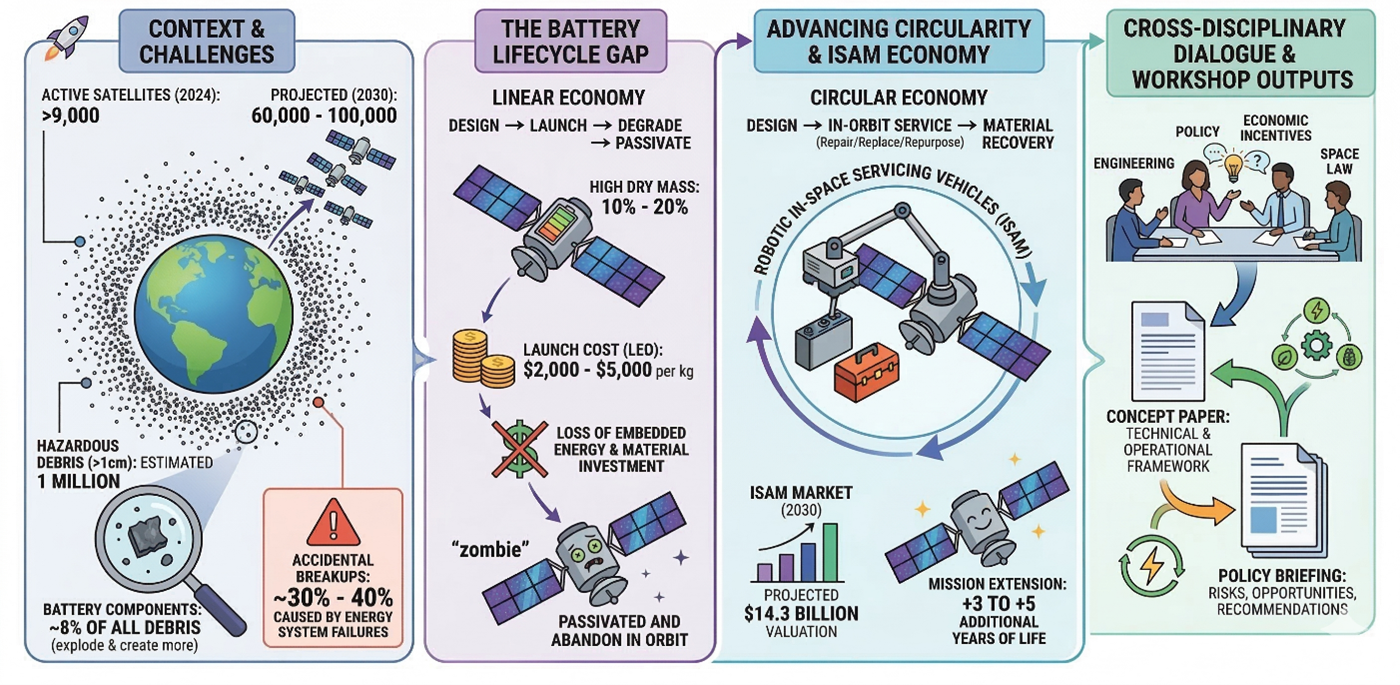
Conceptual framework of the Circular Batteries in Space workshop
Figure 1. Conceptual framework of the Circular Batteries in Space workshop.
(Figures: visual concept by Yige Sun, rendered via Google Gemini AI)

Of the 1 million pieces of hazardous debris larger than 1cm, battery components account for ~8%. Abandoned batteries are active threats: they can explode due to degradation, thermal runaway, or micrometeoroid impacts. Historically, 30% to 40% of accidental fragmentation events have been linked to energy system failures.

The Battery Lifecycle Gap

Battery systems account for 10% to 20% of a spacecraft’s dry mass. With launch costs to LEO at $2,000 - $5,000/kg, abandoning these high-value components represents a massive loss of embedded energy and material investment.

Advancing Circularity and the ISAM Economy

This workshop explores moving beyond abandonment toward systems designed for reuse and repair. This shift aligns with the emerging ISAM market, projected to reach $14.3 billion by 2030. In-orbit battery replacement could extend asset life by 3 to 5 years.

A Cross-Disciplinary Dialogue

Solving the battery circularity challenge requires a complex interplay of:

⚙️ Technical Pathways: Design-for-disassembly, robotic refueling/servicing interfaces, and modular energy storage.
⚖️ Policy & Governance: New regulatory frameworks for orbital resource management and "Right to Repair" in space.
📈 Economic Incentives: Funding models from national research councils, space agencies, and private sustainability programmes.

Workshop Outputs

Through your Expression of Interest (EoI) and participation, we aim to co-develop:

📄 A Concept Paper

Defining strategic pathways for battery systems and design-for-serviceability protocols to enable a resilient and repairable orbital infrastructure.

⚖️ A Policy Briefing

Formulating recommendations on funding models, economic opportunities, and regulatory frameworks to catalyze the $14.3B ISAM economy and mitigate orbital risks.
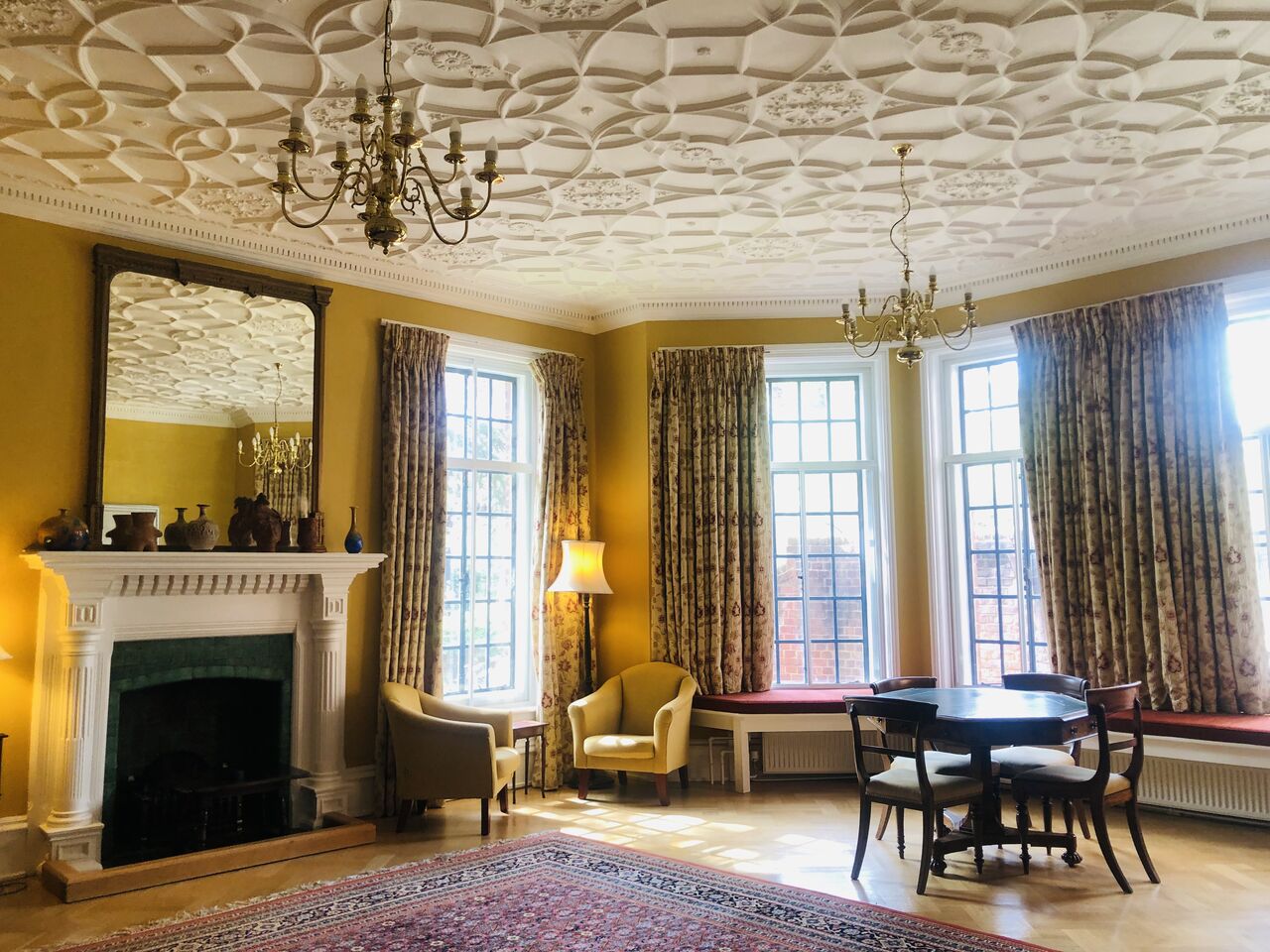
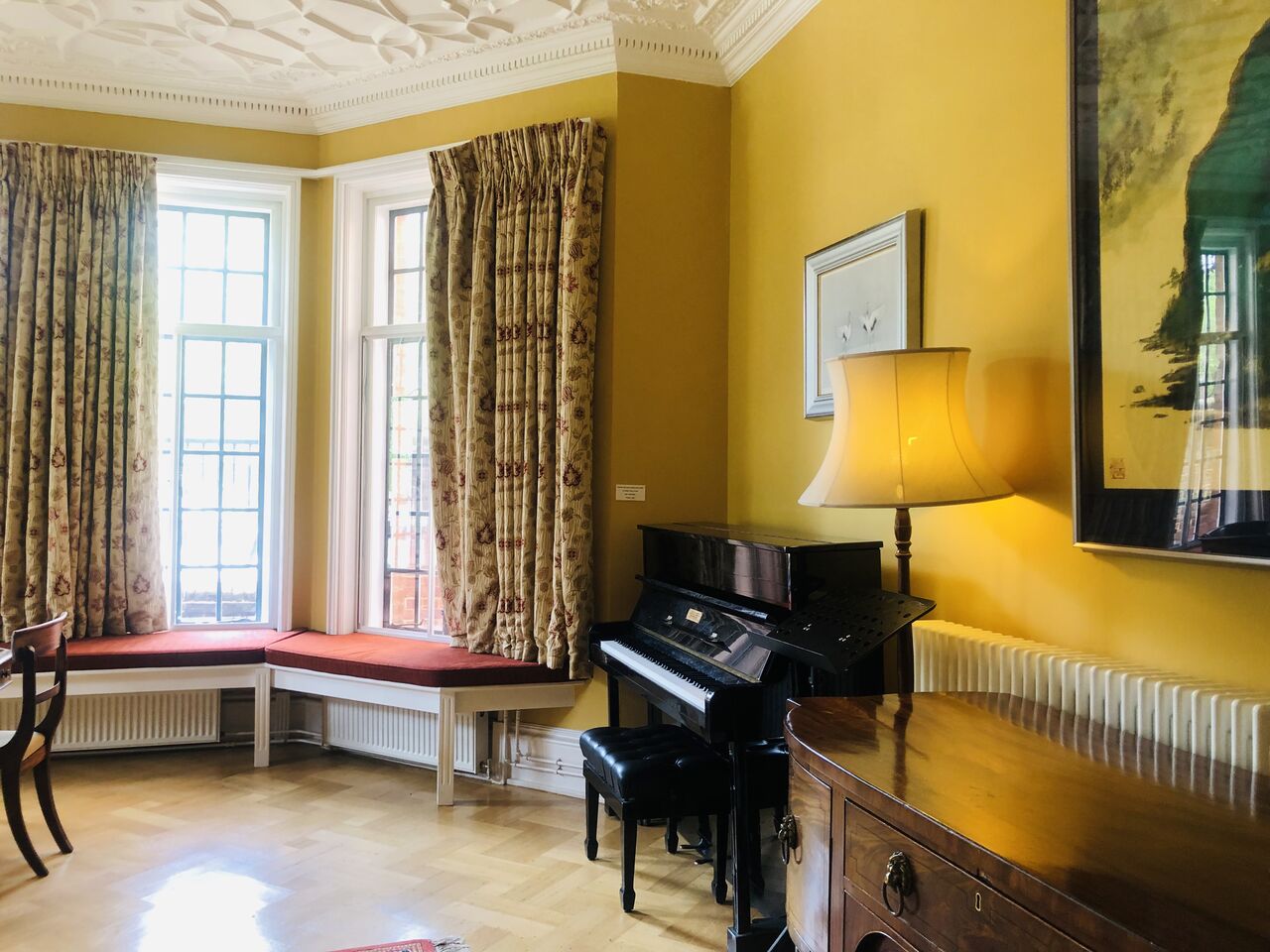
The Venue: Linacre College, University of Oxford

Keynote Speakers

Prof. Martin Freer

Chief Executive Officer
The Faraday Institution, UK

Dr. Adam Mitchell

Materials & Processes Evaluation Engineer
European Space Agency (ESA), EU

Dr. Laura Lander

Battery Life Cycle Analysis
King's College London (KCL), UK

Dr. Rudra Samajdar

Senior Scientist, Electrochemistry
National Physical Laboratory (NPL), UK

Mike Curtis-Rouse

Head of IOSM
Satellite Applications Catapult, UK

Erik Kulu

Founder & CEO
Moliri, Factories in Space, Estonia

Dr. Oguz Karasu

Space economist
Saïd Business School, Oxford, UK

Natasha Scanes

Space Law, Director in the Corporate department of London office
FieldFisher, UK

Prof. Samia Nefti-Meziani OBE

Chair in Robotics and AI
Director of the Birmingham Robotics Institute, UK

Irantzu Garmendia

Project Officer
EU Safe & Sustainable by Design (SSbD) Office at JRC, EU

To Be Announced

Senior Representative
Dept. for Business and Trade (DBT)

Tentative Programme

09:30 - Registration & Welcome Coffee

Participant arrival and networking.

10:00 - Opening & Framework Briefing

Opening remarks and presentation of the pre-drafted Technical Concept Paper and Policy Report points.

11:00 - Expert Keynotes & Invited Talks

Presentations and strategic feedback on the draft frameworks from leading experts spanning battery technology, space systems, robotics, space economy, and space law. (Includes a mid-morning coffee break and transitions into a networking lunch at 12:30).

13:00 - Plenary Panel Discussion

"Building Cross-Disciplinary Ecosystems" - A focused dialogue on breaking down silos and establishing practical pathways for cross-sectoral collaboration to achieve orbital circularity. Chaired by Dr Yige Sun.

Prof. Jin Xuan

Professor, Associate Dean (Research and Innovation), Faculty of Engineering and Physical Sciences
University of Surrey, UK

Prof. Adam Amara

Chief Scientist | Head of School of Mathematics & Physics
UKSA & University of Surrey, UK

To Be Announced

Panelist
TBA

To Be Announced

Panelist
TBA

To Be Announced

Panelist
TBA

To Be Announced

Panelist
TBA

14:00 - Pressure Testing Breakouts

Participants divide into 4 specialized workstreams (Technical, Policy, Economic, and Legal) to stress-test the draft documents against pre-set challenging scenarios.

16:00 - Closing Remarks & Reflection

Summary of key takeaways from the workstreams, outlining the next steps for the Concept Paper and Policy Briefing, and the formal close of the workshop.

16:30 - Networking Drinks & Reception

Continued discussions and formal reception in the Nadel Room concluding the event.

Organising Committee

Dr. Yige Sun

Lead Organiser & Chair
University of Oxford, UK

Robin Morris

Strategic & Operational Liaison
Henry Royce Institute | Oxford, UK

Dr. Oguz Karasu

Strategic Partnerships Advisor
Saïd Business School, Oxford, UK

Joanna Lopusinska

Workshop Coordinator
Department of Materials, Oxford, UK

Advisory Board

Prof. Martin Freer

Chair of the Advisory Board
The Faraday Institution, UK

To Be Announced

senior representative
UK Space Agency (UKSA), UK

Dr. Adam Mitchell

Materials & Processes Engineer
European Space Agency (ESA), EU

Prof. Qiong Cai

Professor in Sustainable Energy and Materials
Sustainability Fellow
University of Surrey, UK

Prof. James Robinson

Associate Professor in Advanced Propulsion
Dept. of Chemical Engineering, UCL, UK

To Be Announced

Policy Lead
UN Office for Outer Space Affairs (UNOOSA)

Special Observers

To Be Announced

Senior Portfolio Manager
EPSRC

To Be Announced

Innovation Lead
Innovate UK

Sponsored By

Practical Information

🏨 Accommodation

If you wish to stay in Oxford during the workshop, please contact and book your accommodation directly through the following recommended platforms:

🚗 Parking

Short Stay: The nearest parking is located on Mansfield Road; however, please note this is short stay only with a maximum limit of 2 hours.

Long Stay: The nearest long-stay facility is the Gloucester Green Underground car park. From there, it is approximately a 15-minute walk to Linacre College.

Register Interest

Submit Expression of Interest (EoI)
QR Code for EoI Form